
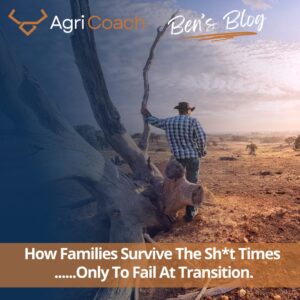



I once had an old bloke say something to me that really stuck.
He said, “Ben, people reckon the hardest part is surviving the tough years.”
The floods.
The droughts.
The low commodity prices.
The high interest rates.
The broken gear and the long nights lying awake wondering how you’ll make it through.
He said people look at those seasons and assume that’s where farming operations are made or broken.
He shook his head.
“That’s just endurance Ben,” he said.
He told me he’d watched farms survive years where nothing went right. Seasons that stripped paddocks bare. Markets that paid bugger all. Banks that kept tightening the screws. The farm survived because Mum & Dad kept turning up. They made the decisions. They carried the pressure and kept the wheels moving forward when stopping felt easier.
That’s how farms survive the hard years.
But then, one day, Mum & Dad want to step back.
Or slow down.
Or they aren’t there anymore.
And that’s when things get complicated. Then more often than not, the wheels fall off.
He said most farms don’t actually fail because of drought, interest rates, or depressed commodity prices.
They fail when they’re passed on.
Not because the land isn’t good.
Not because the business isn’t profitable.
But because no one ever wanted to talk about what happens next.
You see families assume love will be enough. That everyone will be reasonable. That when the time comes, things will just sort themselves out because everyone will do their share.
They don’t.
Some of the next generation want to farm.
Others don’t.
Some live close.
Others are hours away.
Some need income.
Others want a clean break.
And suddenly, the farm that survived everything can’t survive a conversation.
He said he’d seen it too many times. A place held together for decades by Mum and Dads resolve— then slowly pulled apart by good intentions and long silences.
The conversations were non-existent.
The paperwork wasn’t done.
The expectations were never made clear.
The roles were never properly talked through.
There was no plan.
So, when the moment arrived, the farm and the wealth attached became a problem instead of a blessing.
“Land’s patient, real patient” he said.
“Families are not.”
There was no anger in what he said. Just honesty.
He said the farms that make it through succession usually look boring on paper. Plans written down early on. Decisions made before they had to be. Conversations that were uncomfortable at the time — but saved years of resentment later.
Surviving tough seasons takes grit.
Passing on a farm requires a family to be proactive, and it takes humility.
That’s the part people don’t see.
The farm doesn’t fail because it couldn’t survive the hard years.
It fails because no one prepared it for life without Mum & Dad holding it all together.
And that’s a harder problem than any drought, any rate rise, or any bad market ever was.
So, what is the solution?
The families who get this right don’t wait for a crisis or a trigger event.
They start early, while the farm is strong and relationships are intact.
They prepare themselves for a next chapter that matters, they deliberately develop the next generation to lead rather than inherit, and they shape a business that can move without breaking.
Not because something is wrong — but because they understand that endurance gets you through hard seasons, while preparation is what carries a farm beyond the people who built it.
Until next time,
Cheers, Ben
----------------------
Disclaimer: The information contained in this article is general in nature and for education purposes only. It is not financial advice. No one should act on the information without appropriate specific advice for your particular circumstances. Ben Law is a former financial advisor but is no longer licensed and cannot and will not give you specific or personal advice in this article. The Financial Bloke Group Pty Ltd accepts no responsibility for any loss or damage occasioned by any person acting or refraining from action as a result of reliance on the information in this article.