
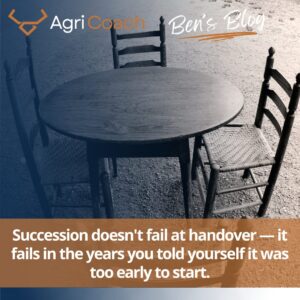



Some farming families go through succession and it just works. No lawyer battles, no sibling resentment, no kid who quietly walked away and never really came back, no family relationships permanently damaged. The generation above steps back, the next generation steps up, the business keeps moving, and from the outside the whole thing looks almost unremarkable. Like it was never really that complicated to begin with. Almost boring!
And when people see that, they reach for the easiest explanation. Good kids. Simple situation. Lots of assets to carve up. Lucky, basically. But that's not what's happening. That's never what's happening.
I was asked to do a keynote for a room of farming families recently — successful, progressive, mid to late forties, kids just wrapping up school and heading off to uni or trades. Every one of them sitting somewhere between five and fifteen years from handing anything over. No crisis driving them there, no lawyer letters in the mail, no family blowup they were trying to recover from. Just a room full of people who had decided, of their own accord, that they weren’t going to put their heads in the sand.
When I asked them why they came on the day, over 80% landed on one of two answers. Either they'd watched a difficult succession play out somewhere in their own history — parents, grandparents, their own family — and decided they weren't going to let that script run again. Or they'd come through a decent one themselves and wanted the same for their kids, except this time on purpose, not by accident or good fortune. Two different answers, but they come from the exact same place — people who looked at something complicated and far away and chose to walk toward it while they still had the luxury of doing right.
Most people don't do that, and frankly, I understand why. When something feels big and distant and uncertain, the natural move is to leave it the bloody hell alone. There's always something more urgent, something actually on fire today that needs your attention right now, and succession — well, succession can wait. The kids need to be older. The business needs your attention. Things need to calm down a bit first. And so the years roll on, things never quite calm down, and eventually you look up and find yourself eighteen months from a transition you haven't prepared for — trying to compress into a hurry what was always going to take years. Trying to have conversations you should have started a decade ago, about things nobody ever wrote down because everyone assumed it was understood.
That's not a succession problem. That's what happens when you let time make your decisions for you.
What those families in that room had figured out is something that, when you say it out loud, sounds almost obvious. They're the kind of people who spend serious money on everything that compounds — better soil, better genetics, better equipment, better agronomic advice — because they understand that what you invest in today shows up three seasons from now. They think in decades, and that's a big part of why they're successful. But somewhere along the way, most of them had never applied that same logic to themselves. To their family. To whether the next generation actually understood what was expected of them, believed they were capable of leading, or even wanted what was being built in their name.
They'd invested in everything except the people sitting around the dinner table. They fixed that. They got off farm, included their next generation and walked in the room.
So if you're reading this and thinking it's time to start — here's where you begin. Not with lawyers, not with accountants, not with ownership structures. You start with alignment. Get the family in a room and find out whether everyone is actually pointed in the same direction, because until you know that, nothing else you build will hold. Think of it like soil health — you don't test it once and tick the box. You keep working it, keep checking it, because the moment you stop paying attention it starts to drift. A family that was aligned two years ago isn't automatically aligned today. Kids grow up, circumstances change, opinions shift, and what everyone silently assumed is understood has a habit of quietly coming apart at the seams. Alignment is where you start, but it's also where you keep coming back. Get that right first, and everything else — the structures, the plans, the legal frameworks — has something solid to stand on.
The families who make succession look easy aren't lucky, and they're not blessed with simpler circumstances or more agreeable kids. They just started earlier than you'd think, on things most people haven't thought of yet. And the window where you can do that calmly — on your own terms, without a clock running — it doesn't stay open indefinitely. Most people don't realise they're standing in it until they've already walked out the other side.
Start now. Or explain to your family later what went wrong.
Until next time.
Cheers,
Ben
----------------------
Disclaimer: The information contained in this article is general in nature and for education purposes only. It is not financial advice. No one should act on the information without appropriate specific advice for your particular circumstances. Ben Law is a former financial advisor but is no longer licensed and cannot and will not give you specific or personal advice in this article. The Financial Bloke Group Pty Ltd accepts no responsibility for any loss or damage occasioned by any person acting or refraining from action as a result of reliance on the information in this article.